Frayme
Frayme responds to a shift in how people expect to interact with the web. Browsers have remained largely unchanged, while user behaviour, device connectivity, and expectations around privacy have evolved. The opportunity was to rethink the browser as something more adaptive and integrated. Not just a tool for navigation, but a product that could support richer interactions between user, device, and data.
The starting point was to define the problem clearly. Existing mobile browsers limit control, restrict extensibility, and fail to surface more advanced capabilities in a way that feels usable or relevant. This creates a gap between what technology allows and what users can realistically access or understand.
*Name changed to comply with NDA agreement.
MY ROLE
My role focused on shaping both the product thinking and the design system behind it. I mapped user needs across different levels of technical confidence, from everyday users to developers, and identified where current experiences create friction. This informed a set of core journeys and feature priorities, grounded in usability but open to more advanced interactions. This included but was not limited to:
User Experience
Product Research
User Interface Design


ONBOARDING FEATURES
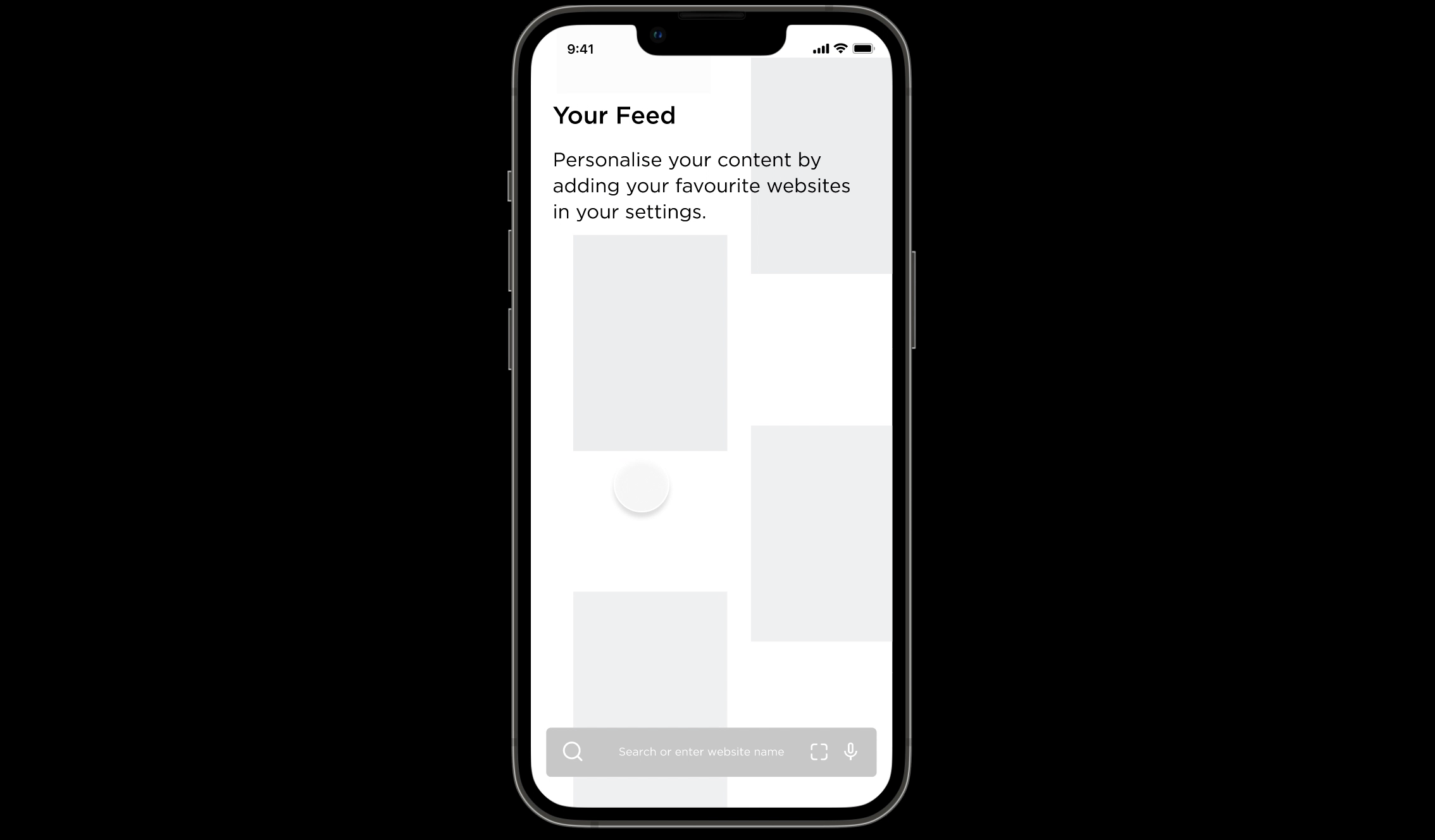
A key part of the work focused on shaping the onboarding journey as a first impression of both product value and its underlying logic. Rather than introducing features all at once, the experience is paced to highlight what makes Frayme distinct. Bluetooth connectivity and data privacy are positioned as foundational, not secondary. Users are guided through these capabilities early on, with interactions that demonstrate their relevance in context, helping to build confidence from the outset.
e Fun!


TAB FUNCTIONALITY
I explored new ways of designing around interface patterns. Tabs became a key area of investigation.
Rather than treating them as static containers, I looked at how they could behave more dynamically,
supporting better organisation, visibility, and flow between tasks. This included rethinking hierarchy,
improving navigation, and allowing for images to be pulled from current active sessions.

DESIGNING FOR ACCESSIBILITY
Accessibility was considered at both a functional and systemic level. This meant designing
interactions that are easy to interpret, reducing unnecessary complexity, and ensuring that
key actions remain clear regardless of user context. The goal was to create an experience that
feels intuitive across different levels of familiarity, without limiting more advanced use.
Interested in working together?
Get in Touch!
Email: heinze.heike@gmail.com
Twitter: @bonjour_heike